
-
 Media gallery

White
- Regular price
- $18.00
- Regular price
-
- Sale price
- $18.00
- Unit price
- per
Couldn't load pickup availability
Description
Description
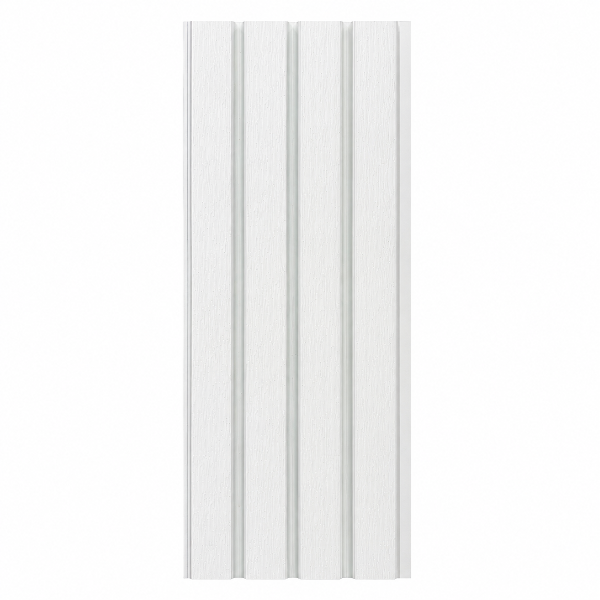
White WPC Outdoor Wall Panel
Crisp, fluted wood-plastic composite cladding in white — part of EMU Design's outdoor WPC panel collection.
On this page
White overview
White is EMU Design's crisp, clean colourway in the outdoor WPC (wood-plastic composite) panel range. The fluted profile — raised vertical slats with recessed lines — gives a wall depth and a defined shadow line without fixing individual timber slats one by one. It's positioned within the collection as the option for modern facades, fences and courtyards, working as a bright, contemporary contrast alongside the range's darker and warmer tones such as Charcoal and Dark Teak.
- Fluted, crisp white finish that reads as a bright, contemporary contrast against dark render, black steel and greenery
- 219 × 26 mm profile available in three lengths — 1.8 m, 2.4 m and 2.9 m
- Suited to modern facades, feature fences, courtyard walls and entrance details
- Sold as a panel only — a complete exterior system also needs battens, trims and compatible clips (see below)
- Ships Australia-wide; showroom viewing available in Rouse Hill and Penrith, NSW
White sizes & prices
White is available in three panel lengths, all sharing the same 219 × 26 mm profile.
| Length | Profile | Price |
|---|---|---|
| 1.8 m | 219 × 26 mm | $18.00 |
| 2.4 m | 219 × 26 mm | $24.00 |
| 2.9 m | 219 × 26 mm | $29.00 |
Where to use White
Being the brightest tone in the range, White is typically chosen as a contrast or feature colour — set against dark render, black steel fixtures, timber decking or greenery, rather than blending into the background.

Suitable applications for the outdoor WPC panel range include:
- Modern facade feature strips and entrance details
- Fence cladding and boundary feature panels
- Courtyard and outdoor living feature walls
- Selected façade areas, assessed by a qualified builder where structural or waterproofing requirements apply
For building façades, balconies, high walls or boundary structures, the panel is only one part of the system — substrate, battens, drainage path, ventilation, expansion allowance and mechanical fixings all need to suit the specific project.
What is a WPC panel?
WPC panels are made by combining wood fibre with a recycled polymer, then pressing the mix into the fluted profile you see here. The reason this matters more for a light colour like White than for a timber-tone panel: the pigment runs through the material itself during manufacturing, rather than sitting on top as a coat of paint or stain. A painted timber slat can show an uneven coat or a touch-up line — a factory-through-coloured panel like this doesn't have that same failure point.
That doesn't tell you everything, though. "WPC" on its own isn't a UV rating, a fire rating or a resin specification — ask EMU Design for the technical data sheet for White before specifying it on a project where those numbers need to be confirmed in writing.
Weather & water exposure
A common assumption is that anything labelled "outdoor" can go straight onto an exposed wall with no further prep. That's not the case here — the wall behind a White panel still needs its own drainage, ventilation and weatherproofing; the panel itself isn't a substitute for a compliant waterproof membrane.
Installation, clips & trims
On a dark panel, a small gap at a join, a slightly mismatched trim, or a mark left by a fixing tends to disappear into the colour. On White, the same issues stay visible — so it's worth confirming the right hardware for this profile before installation starts, rather than adjusting on site. Typically this means:
- Battens set to create the fixing and drainage plane behind the panel
- Trims and external-corner pieces sized to the White profile — an off-profile trim reads more obviously on a light wall than a dark one
- Fixing points chosen so brackets don't leave visible marks or discolouration against the light surface
- Clearance for airflow and a water-escape path behind the cladding
A small, low feature wall can suit an experienced DIY installer. For anything larger — full façades, high walls, corners, or wind-exposed areas — get a qualified installer to assess it before ordering, rather than finding out mid-install that the wall needs different support.
Before you order
| Check | Why it matters for White |
|---|---|
| A physical sample, viewed on-site in the actual light | A photo or screen won't show how the white reads next to your render, decking or fence colour — light direction changes it |
| What it will sit against (render colour, steel, greenery) | White works as a contrast feature — confirm the surrounding surfaces actually give it something to contrast with |
| Wall width & height, minus openings | Determines panel count and lengths needed |
| Supporting structure & battens | Fixing points must suit the wall and panel direction |
| Clips, screws & trims sized to this profile | Mismatched hardware is more visible on a light panel than a dark one |
| Cutting & waste allowance | Actual usable coverage is lower than raw panel length × width |
Send EMU Design your wall measurements, a sketch or photos and they can help estimate an approximate panel count — get in touch here.
White: frequently asked questions
Is White a good match for modern facades?
Yes — within the outdoor WPC collection, White is positioned as the crisp, contemporary option for modern facades, fences and courtyards, giving a bright contrast against darker cladding, steel fixtures or greenery.
Does White show dirt and stains more than the darker colours?
Generally, yes — lighter finishes show surface dust, water marks and staining more visibly than Charcoal or Dark Teak. Ask EMU Design for the specific cleaning and care instructions for White, and avoid harsh chemicals or pressure-washing until confirmed suitable.
Is White waterproof?
No panel in this range should be treated as a stand-alone waterproofing layer, White included. If anything, it's worth checking drainage and flashing details more carefully here — a wall that doesn't drain properly can leave visible watermark streaking on white cladding faster than it would on a dark colour. Confirm the exact water-resistance spec for White with EMU Design before relying on it as your only weather barrier.
Can White panels be installed horizontally?
Yes, the fluted profile still works turned horizontally, though it changes how joins, drainage and light hit the surface. On White specifically, horizontal joins tend to show more than they would on a darker colour, since there's less colour variation to disguise them — confirm horizontal installation is approved for this panel, and plan where joins will fall before finalising the layout.
How many White panels do I need?
Start with wall width and height minus any openings, then add an allowance for cuts and waste at joins. Since White is often used as a feature strip or accent rather than a full wall covering, also decide exactly how much of the wall you actually want covered — send EMU Design your measurements, a sketch or photos and they can help confirm an approximate count.
What sizes and prices are available?
White comes in 1.8 m ($18.00), 2.4 m ($24.00) and 2.9 m ($29.00) lengths, all with a 219 × 26 mm profile. Confirm current stock before ordering.
Can I use White on a fence?
It can work as a fence cladding finish, but it shouldn't replace the fence's structural posts or framing. Because White shows weathering, splashback and general wear more openly than a darker colour, factor in how exposed the fence line actually is — full sun, sprinklers, road spray from a driveway — before committing to a light colour there. Confirm wind exposure and fixing points with EMU Design first.
Pairs well with
White is most often used as a contrast colour, so comparing it against a darker tone before you order helps avoid a mismatch once panels are on the wall:
Shipping & returns
Because transport marks and dirt show up faster on White than on a dark panel, it's worth checking each piece for scuffing or marking as soon as it arrives — before installation, while it's still easy to flag. Orders ship Australia-wide with tracking; contact EMU Design straight away if a delivery arrives damaged. See the returns & exchanges policy for full terms — unused panels in original packaging may be eligible for return within the applicable period, confirmed during the return process.
Shipping and Returns
Shipping and Returns
We carefully prepare and dispatch every order to ensure it arrives in excellent condition. Shipping times may vary depending on your location and product availability, and tracking information will be provided once your order has been dispatched.
If your order arrives damaged or there is an issue with your shipment, please contact our customer support team as soon as possible. We'll work with you to resolve the issue and ensure you're satisfied with your purchase.
Return Policies
Return Policies
We want you to be completely satisfied with your purchase. If you're not happy with your order, you may request a return or exchange within the applicable return period, provided the item is unused and in its original condition and packaging.
To start a return, please contact our customer service team with your order details. Return eligibility, processing times, and any applicable conditions may vary, and additional information will be provided during the return process.
Size Guide
Have a question?
Notified by email when this product becomes available

You may also like
F.A.Q
Everything You Need to Know Before Choosing Your Wall PanelsEMU Design supplies a range of modern wall and ceiling products, including acoustic slat wall panels, flexible acoustic panels, outdoor WPC wall panels, SPC marble sheets and soft stone panels. We offer a variety of colours, finishes and sizes for residential and commercial projects.
Yes. You’re welcome to visit our Rouse Hill showroom to view our products, colours and finishes in person. We recommend contacting us before visiting so we can make sure the products you’re interested in are available to view.
Yes. Sydney-wide delivery is available. Delivery cost depends on your location, order size and product length. Contact us with your suburb and order details for a delivery quote.
Yes. We work with experienced and professional installers who we can confidently recommend for your project. Simply send us photos and measurements of the area, and we can help coordinate the installation and provide the right advice for your project.
Simply send us your wall or ceiling measurements, including the width and height, and we can help calculate the approximate number of panels required. We usually recommend allowing a small amount for cutting and wastage.
Many of our products are suitable for DIY installation if you have basic tools and installation experience. However, for larger areas, high walls, ceilings or more complicated finishes, we recommend using an experienced installer.
Yes. Most of our ranges are available in multiple colours and finishes, including timber-look, black, white, walnut, oak, marble and other contemporary options. Availability varies depending on current stock.
Yes. You can visit our showroom to view available samples and finishes. We can also send photos or videos of available colours to help you choose.
Yes. Suitable adhesive and selected installation accessories are available for many of our panel products. Let us know what product you’re installing and we can advise what you may need.
Yes. As a direct supplier, we can offer competitive pricing, including better rates for builders, installers, trade customers and larger-volume orders. Contact us with the product and quantity required for a quote.
